Speaking Out Against Bull Riding

For the third year in a row, NHARL volunteers had vegan boots on the ground at the SNHU Arena in Manchester to protest the Professional Bull Riders (PBR) Tour.

The League led two impactful demonstrations before each scheduled show, Friday, Dec. 15, and Saturday, Dec. 16.

Our posters invited eventgoers to consider the experience of the bull and the very real possibility that animals could get injured and potentially euthanized that evening.

New this year, we also showed video of bulls getting hurt at PBR events, which played on a loop as eventgoers walked past.

While most ticketholders were not visibly receptive to the message that bull riding is animal abuse, we succeeded in handing out more than 200 flyers (shown below), reinforcing the fact the bull riding isn’t fun for everyone.

What You Can Do

  • Don’t buy a ticket!
  • If you live in Manchester, contact us to find out how you can help.
  • Contact the PBR sponsors, including Tractor Supply, to complain.

Venison donations may come with a side of lead

Commentary by Joan O’Brien
NH Bulletin (republished by Seacoast Online)
November 6, 2023

It’s deer hunting season, and once again the New Hampshire Food Bank is promoting its “Hunt for the Hungry” program, encouraging hunters to donate deer meat (venison) to the food bank.

It’s a feel-good program that gets a lot of positive press. What’s not mentioned in the promotion is the very real danger that donated venison could contain lead.

It’s a real possibility, one that Scott Mason, executive director of New Hampshire Fish and Game, touched on at the September New Hampshire Fish and Game Commission meeting. Describing a recent ballistics presentation, he said, “… As the bullet travels through the target it is shedding lead … now you have lead in your meat.”

Lead bullets fragment into hundreds of tiny pieces upon impact. Studies show that fragments too small to detect by sight, touch, or chewing can be present in the flesh of deer shot with lead ammunition.

Hunters are accustomed to discarding meat near the wound site, but lead fragments have been shown to travel up to 18 inches from the point of impact.

This X-ray image above shows more than 450 lead fragments spread through the neck of a deer shot with a lead rifle bullet. (Courtesy of the National Park Service)

Recommendations for safe blood lead levels have been moved lower and lower over the years as researchers learn more about the effects of lead. Today we know that no amount of lead exposure is safe. “Even low levels of lead in blood have been shown to affect learning, ability to pay attention, and academic achievement,” according to the CDC.

While the Hunt for the Hungry program may be well intentioned, venison donations could be putting a vulnerable population at risk.

Nancy Mellitt, director of development at the NH Food Bank, says the issue of lead in venison donations has never come up. “Any meat donated to the food bank is processed by a USDA butcher. … They are experts in that field,” she said.

Beyond the dinner plate, the use of lead ammunition also harms wildlife and the environment. Birds of prey, foxes, and other scavenging animals get lead poisoning from eating contaminated carcasses and “gut piles” left behind by hunters.

Eagles are especially vulnerable to the effects of lead, because their acidic stomachs quickly break down and absorb any ingested lead. A piece of lead the size of a grain of rice is enough to kill an eagle. Lead poisoning can also make animals lethargic and disoriented so that they are at greater risk of fatal accidents.

Ducks, geese, and swans are also highly susceptible to lead poisoning because they naturally consume small rocks (“grit”) to help them grind food in their gizzards. Lead fragments from spent bullets or fishing tackle are easily mistaken for suitable grit.

In 1991, the use of lead shot for waterfowl hunting was banned nationwide. The impact of lead on waterfowl was recognized more than a century earlier, but federal efforts to curb the use of lead ammunition for hunting have a long history of opposition.

The potential for lead contamination in donated venison is not unique to New Hampshire. Almost all states have some sort of game meat donation program. Nationwide, hunters donate thousands of pounds of meat to the needy, yet the risk of lead exposure is largely unaddressed. Few states do more than publish best practices for minimizing lead exposure and warnings that pregnant women and small children are most at risk.

According to Martin Feehan at the Massachusetts Division of Fisheries and Wildlife, “The issue of lead is less of a concern in Massachusetts when it comes to our venison donation program, predominantly because Massachusetts doesn’t have rifle hunting.” Deer hunters in that state either hunt with a bow or use shotguns, which have a slower projectile speed, and thus the bullet, or “slug,” generally stays intact. The majority of deer hunted in Massachusetts are taken by bow hunters, Feehan said.

This author does not recommend bow hunting. While it may eliminate the dangers of lead ammunition, it can mean a long, slow death for the animal. Bow hunters deliberately wait 30 to 60 minutes, and sometimes up to 6 to 12 hours (if the shot was poorly placed), to give the animal time to die.

In states where rifle hunting is allowed, the threat of lead contamination could be eliminated if hunters used non-lead ammunition. Alternatives do exist, including bullets made from copper, and have been shown to be just as effective. (Hunters can learn about these alternatives from organizations such as the North American Non-Lead Partnership.)

New Hampshire Fish and Game could aid the transition to non-lead ammunition by offering hunters incentives to make the switch.

X-raying donated venison to check for lead has been tried in some states, and Minnesota continues the practice. It is an added expense that also highlights the waste that results from hunting with lead ammunition. In the decade before 2021, Minnesota’s lead inspectors rejected 6,700 pounds of deer meat, the equivalent of approximately 168 deer being thrown away.

Another solution to the problems caused by lead ammunition would be not to hunt. Hunting for meat may be better than purchasing the products of industrial animal agriculture, a cruel and environmentally damaging system, but not eating animals at all is even better. It’s possible to get all the nutrition we need without eating meat (a fact easily backed up by Googling “How do vegans get their protein?”).

The protein needs of the NH Food Bank could be met with plant sources, such as beans, chickpeas, nuts, and even the new plant-based meat substitutes. In addition to being healthy and lead free, many plant-based staples can be stored on the shelf almost indefinitely, making them a practical and efficient way to feed the hungry.


Dairy Is Scary Message at the Howl-O-Ween 5K

On October 21, 2023, the New Hampshire Animal Rights League took part in the Animal Rescue League of NH’s annual Howl-O-Ween 5K, sharing a message of “Dairy Is Scary” and handing out vegan Halloween treats and literature.

Our message was apropos, because the New England Dairy “Mobile Dairy Bar” was also at the event, giving out samples of cow’s milk from their refrigerated van.

It seems we caused a bit of a stir, with a representative from New England Dairy even coming over to our table! The representative told us that they work with only small, local dairy farmers, but we know the same cruel agricultural practices apply on both big and small farms.

Despite her efforts to put dairy in a positive light she could not refute any of the scary dairy facts.

Scary Dairy Facts:

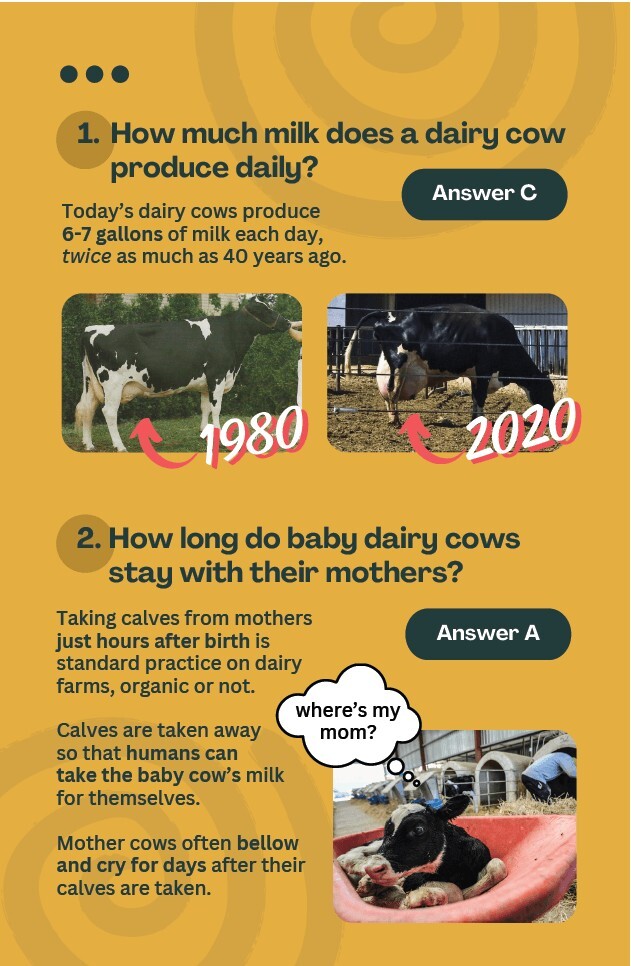
  • Cows need to be pregnant and give birth to produce milk.
  • Taking newborn calves from mothers just hours after birth is standard on dairy farms everywhere, organic or not.
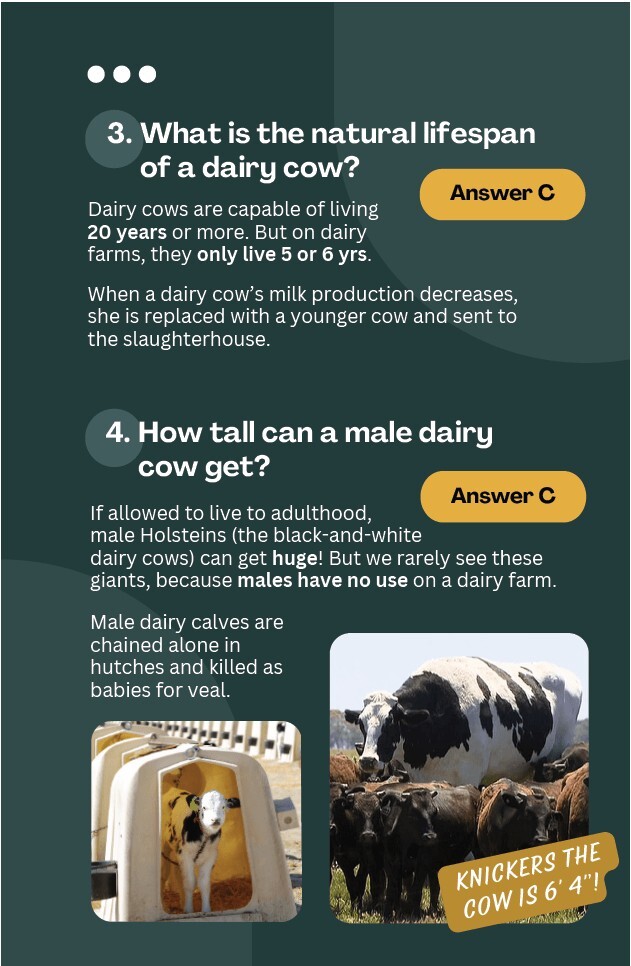
  • Male calves have no use on a dairy farm, so they are chained in crates and sold as veal.

Plant milk saves the day!

Luckily,  there is no shortage of delicious dairy-free products, including ethical and delicious vegan milk chocolate from Trupo Treats, which we handed out at the event.

Our table enjoyed a non-stop stream of visitors, and many signed up for our mailing list. For our canine visitors, we had a selection of vegan dog treats — something to satisfy every pooch’s palate.  

NHARL was the 2nd place fundraiser!

In addition to our table, this year we also registered a NHARL Team to do the 5K and raise money for the Animal Rescue League.

While our captain Liz was a lonely team of one, thanks to your generous donations we earned 2nd place in the list of Top Team Fundraisers, raising $477 for the shelter!

Thank you to those who donated to the NHARL team and to everyone who stopped by our table!

Have a happy and dairy-free Halloween!

Summer Outing a Big Success

We had another perfect weather day for the New Hampshire Animal Rights League’s annual summer outing held August 12, 2023 at Four Tree Island, Portsmouth!

President James Glover spent the day behind the grill, with his volunteer sidekick Trevor, serving up plant-based burgers from our friends KindRoots in Somerville, MA.

Volunteers Felisha, Carole, and Lynette were indispensable, setting up beforehand and doling out sides of pasta salad, potato salad, and chips.

Dessert was a decadent platter of mouthwatering vegan brownies and chocolate chip cookies.

Hangin’ Out on the Island

Our annual summer outing gives people who care about animals an opportunity to connect with like-minded individuals. Guests enjoyed seeing old friends and making news ones.

Sno Kones!

Nothing says fun quite like a Sno Kone machine! Linda and Derek jumped in, serving up these frosty creations to our younger guests. 

Speaking up for sea life

The theme for that day was protecting sea life and the ocean. Fish are intelligent animals who feel pain just as we do. Because no U.S. law regulates the treatment of fish, both the commercial fishing industry and fish farms treat fish in ways that would be criminal if they were dogs or cats.

Posters were on display with information about the harm caused by fishing, along with handouts for visitors to take. Many people who were not signed up for the outing stopped to learn more, and we invited them to enjoy a delicious vegan burger.  

Thank you!

Thank you to everyone who came out for this event, to all our helpers, and to those who made donations. We couldn’t do this work for animals without your support.

Speaking up for fish at the Market Days Festival

New Hampshire Animal Rights League is pleased to share the news of our successful outreach efforts at the Market Days Festival in downtown Concord, NH. 

During this three-day event (June 22- 24), we spread the word about the work we do for animals and made sure everyone who stopped left knowing that Yes, Fish Feel Pain.

(We also snuck in a Dairy is Scary message to accompany our oat milk latte giveaway.) 

Visitors to our booth not only learned that there is scientific evidence that fish experience pain, but also that commercial fishing is cruel, destructive, and kills great numbers of sea turtles, dolphins, and other non-target sea animals.

  • Bottom trawlers (left above) drag nets larger than football fields along the ocean floor, scraping up everything in their path, including non-target marine life — known as “bycatch” — while destroying underwater ecosystems in the process.

  • Long line fishing (right above) uses thousands of baited hooks hanging from a single line which can be 60-120 miles long. Sea turtles, dolphins, sea birds, and many other non-target fish and aquatic animals are caught on these lines. Marine animals may spend hours or days impaled on hooks before the gear is hauled up.

Seeing is Believing

More than 300 people, young and old, agreed to watch the following 1-minute video, “Do Fish Feel Pain?

Those who watched the video received a free can of vegan cold brew coffee from RISE Brewing Co. (or a lemonade) along with some conversation about what they had seen.

Fish Toys

We gave out fish backpack key chain “fidget” toy with a thought-provoking tag: 
Please be my friend by letting me live in my underwater home.”

Goodie Bags

We handed out more than 250 “goodie bags” containing vegan literature (sampling below), coupons, and Swedish fish (an accidentally vegan candy), tagged: “The only fish you should eat.”

Movie Poster

We recommended the film Seaspiracy (watch on Netflix or Google “watch Seaspiracy for free”).

Information cards

We created and shared information cards about:

  • Right whales
  • Lobsters
  • Catch & Release Fishing
  • Risks of Eating Fish

Dairy is Scary

As a final bit of advocacy, we shared these scary dairy facts as visitors selected their non-dairy milk latte:

  • Cows need to be pregnant and give birth to produce milk.
  • Taking newborn calves from mothers hours after birth is standard practice
    on dairy farms everywhere, organic or not.
  • Male calves have no use on a dairy farm, so they are chained in crates and sold as veal.

Thank you

Thank you to all our supporters and to everyone who stopped by to learn about the harms of fishing and eating fish.

Spreading the word that dogs can be vegan

NHARL was on site at the NHSPCA’s annual PAWS Walk fundraiser talking about vegan diets for dogs.

This year we also had a group of members and supporters walking as “Team NHARL,” raising more than $700 for the NHSPCA (participants Valerie and Laureen not pictured). 

New research supports vegan diets for dogs

Until recently, little data was available about the health of dogs on vegan diets. But there are now eight such studies in leading scientific journals, and all but one found that the healthiest and least hazardous diet for dogs is a nutritionally sound vegan diet

While pet food advertisers like to compare dogs to wolves, a dog’s digestive system is different from his wolf ancestors, we explained. Over 15,000 years of living among humans, dogs evolved to eat whatever people gave them — which until modern times would not have included much meat. 

Dogs don’t need meat; dogs need protein.

We gave away samples of vegan dog treats made by V-dog and handed out a brochure with more information, along with pamphlets from Farm Sanctuary and Vegan Outreach.

Thank you!

Thank you to Team NHARL and to everyone who stopped by to learn about vegan diets for dogs.

Get some rest, and we’ll see you next year!

NHARL Takes on a New Puppy Store

Over Memorial Day Weekend, NHARL was out in force protesting a new puppy store that opened in Manchester. 

A description of the store is included in a letter to the Union Leader written by one of our board members.  

Along with holding signs, we were able to have some conversations with curious onlookers about the problem with pet store puppies.

We also handed out the 2-sided flyer shown below (click for printable PDF).

Successful Outreach at NH Fish & Game Event

New Hampshire Animal Rights League is delighted to share the news of our successful outreach efforts at NH Fish & Game’s Discover Wild NH Day held April 15, 2023 in Concord.

During this popular family event that attracts thousands, we educated people about the harm to wildlife and the environment caused by lead ammunition.

In the photo above, Caelin explains to a young visitor that a piece of lead only the size of a grain of rice is enough to kill an eagle.

Our tent attracted non-stop visitors, with kids waiting in line to spin our “Am I Safe from Lead?” wheel.

Accomplishments

  • Educated hundreds of people, young and old, about the harm lead ammunition causes to wildlife and the environment.
  • Sounded the alarm about the dangers lead poses to bald and golden eagles, foxes, bobcats, and other animals, who can become sick and die from consuming contaminated prey and carcasses.
  • Connected with fellow exhibitor The Loon Preservation Committee in our shared desire to protect wildlife from lead poisoning. The Loon Preservation Committee was behind the New Hampshire law banning the sale and freshwater use of lead fishing tackle to protect loons.
  • Spoke to Scott Mason, Director the New Hampshire Fish and Game Department about the dangers of lead ammo, when he stopped by our tent at the start of the event.

Literature

We handed out a brochure we created for the event, Get the lead out of hunting.

PosterS

We displayed the following posters to discuss with visitors to our booth.

Letter Signing Campaign

We invited children and adults to sign our letter asking NH Fish and Game to better educate hunters about the dangers of lead ammunition and make it easier for them to switch to non-lead ammo.

Hundreds of people signed on with enthusiasm. Our plan is to present the letter to the NH Fish and Game Commission to start a dialog about what can be done to address this problem in New Hampshire.

Prizes!

Winners of our spinning wheel contest went home with a “Huggers” stuffed animal (eagle, fox, or black bear), and we also gave kid visitors a set of toy binoculars  to reinforce the idea that wildlife should be enjoyed, not destroyed.

Next year we will bring a lot more prizes, because the event was so well attended that we ran out of everything before noon!

Thank you to our volunteers and to everyone who stopped by to learn about the harm caused by lead ammunition.

This mother and baby loon enjoy some protection from lead poisoning, because in 2016 the sale and use of lead fishing tackle was banned in New Hampshire.

Speaking Out Against Bull Riding

As always, the New Hampshire Animal Rights League was on the ground at the SNHU Arena in Manchester to protest the Professional Bull Riders (PBR) Tour.

The League led two impactful demonstrations before each scheduled show — Saturday evening, Dec. 17, and Sunday afternoon, Dec. 18.

Thank you to everyone who came out — especially those who were there for both shows! — to speak up for bulls. 

Educating the public

While most ticketholders were not visibly receptive to the message that bull riding is animal abuse, demonstrators nonetheless succeeded in handing out more than 100 flyers (shown below).

The flyer content was inspired by the arguments we hear from those who think bull riding is harmless.

Going inside the arena

View from inside the SNHU Arena

Although supporting the PBR (or any business that uses animals for profit or entertainment) is discouraged, one NHARL board member did go inside to see first-hand what the bulls are subjected to. She writes:

It was pretty awful being inside the arena. I did see “eye white” and “diarrhea butt.” When the bull is in the chute and the rider is getting mounted, sometimes there was an overhead view on the big screen. The bulls are pretty calm, like they know the routine, but the crew will punch or pinch the bull to upset him so the rider can make sure he has a good grip before the gate opens.

The least experienced riders went first and were thrown off within 4 seconds. In most cases the bull would quickly look for the exit gate and leave the ring (he probably gets a reward out back). But sometimes the bull would keep bucking without the rider, because the flank strap was still tight, or he’d charge at the ring crew before leaving.

And a few times the now rider-less bull seemed like he didn't want to leave, and would charge at the crew and run around the ring. In this case a guy on a horse with a lasso would rope the bull and lead him to the exit.

The music was really loud, and they had the pyrotechnics, and there was this stupid clown guy telling jokes and shooting prizes into the stands. Overall, it was just a completely inappropriate setting for a peaceful herd animal.

I did not see any bull become visibly injured while I was there, but I left before the show ended.

What You Can Do

Vegan Candy and Conversation at the Howl-O-Ween 5K

On October 22, 2022, the New Hampshire Animal Rights League took part in the Animal Rescue League of NH’s annual Howl-O-Ween 5K with table featuring vegan Halloween candy and literature.

During this popular event, where costumed dogs and their people run a 3-mile race, we brought attention to less fortunate animals — those raised and killed for food.

Using Halloween candy as a starting point for talking about veganism, we explained why gelatin is gruesome and dairy is scary, while offering up a list of cruelty-free candy options.

vegan Dog Treats

For our canine visitors, we had two kinds of pumpkin treats — both very popular with the dogs who stopped by our table.

Why Do We Love One and Eat the Other?

Unfortunately, people who love dogs do not necessarily extend that care and concern to cows, pigs, and other animals considered food. To illustrate, among the dog lovers we met at the 5K event was a butcher, a turkey farmer, a pheasant hunter, and a woman who swears by her “paleo” diet.

While these folks haven’t yet recognized that all living beings should be spared unnecessary suffering, we also met quite a few vegans and vegetarians at the event.

Everyone went home with a bag of vegan candy and some vegan literature (shown below), in hopes of planting seeds.

Thank you to our volunteers and to everyone who stopped by our table.

Happy and cruelty-free Halloween!