“Where do you get your protein?” said the non vegan to the vegan.
“The same place the animals you eat get theirs!” replied the vegan.
The truth? Most Americans (vegan or not) already overconsume protein. Meanwhile, fiber — a nutrient most people are deficient in — is abundant in plant-based diets and practically absent in animal products. Yet nobody seems panicked about a nationwide fiber deficiency. So, enjoy this bowl packed with fiber and plenty of protein.
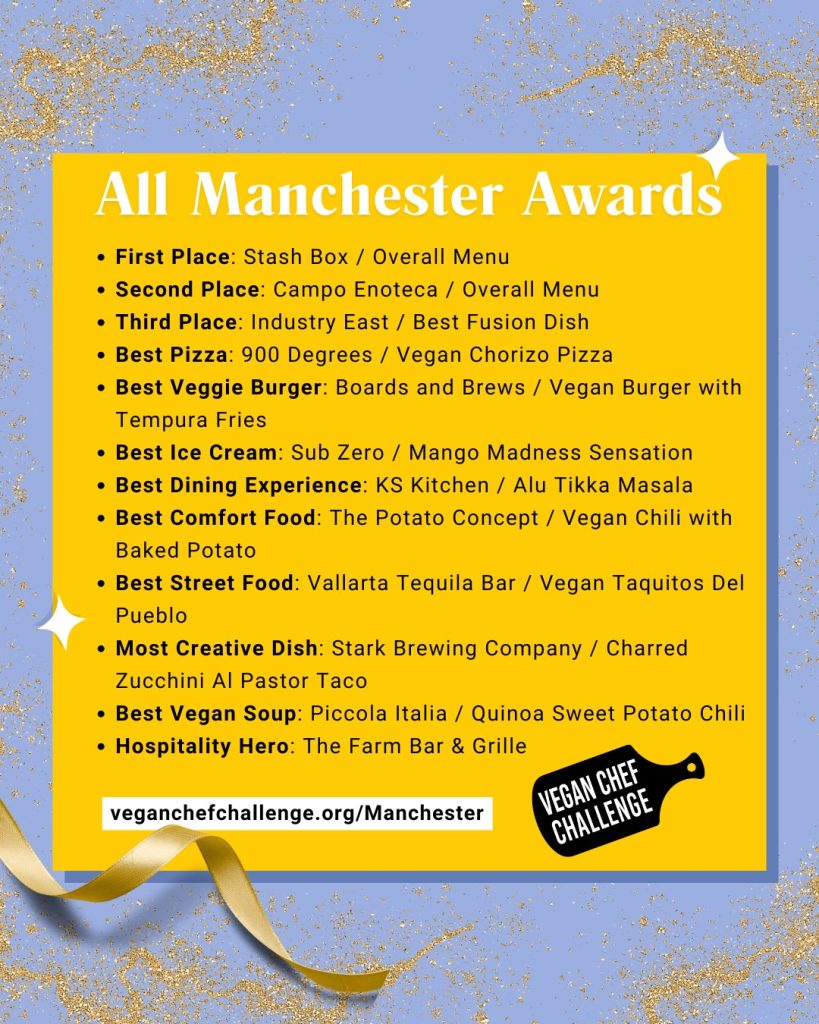
On May 31, 2025, we wrapped up the month-long inaugural Manchester Vegan Chef Challenge with an awards ceremony at KS Kitchen.
We had a total of 12 local businesses join the challenge, and more than 250 community voters provided feedback on their favorite dishes through ratings and reviews.
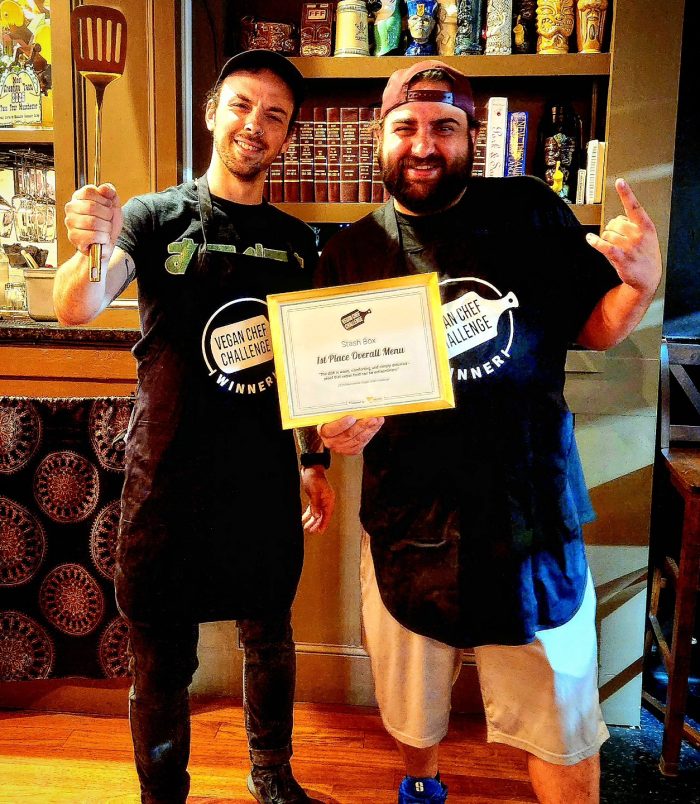
Above, Chef Ian (left) and Chef Jeff of Stash Box pose with their 1st place award, which included a golden spatula!
We’re deeply grateful to the participating restaurants for their creativity and commitment, and to everyone who sampled the dishes and cast a vote. Your enthusiasm helps demonstrate the growing demand for delicious, accessible vegan food in Manchester and beyond.
We’re excited to bring the event back in May 2026 and hope to see even greater participation!
Did you know that eating vegan is one of the most powerful ways to protect the planet?
Today at the Nashua Sustainability Fair, we shared how choosing a plant-based diet reduces our ecological footprint, helps preserve biodiversity, and spares countless animals from suffering.
Familiar Faces
It was a delight to see NHARL friends Anita and Dave, representing New Hampshire Audubon, and The Sleazy Vegan serving up delicious plant-based comfort food right across from our booth!
Carbon Foodprint Quiz
We drew people to our table by asking if they wanted to take our 3-question “carbon foodprint” quiz. The quiz opened the door for a conversation about how animal agriculture harms the environment.
Hardly anyone got Question #3 right — giving us the perfect chance to highlight the climate impact of dairy, which ranks just behind beef.
Water + Carbon + Nitrogen Footprint of Food
Our impactful poster, created using data from the UNH Sustainability Institute, conveyed how resource-intensive and polluting animal-based products are compared to plant-based food,
Goodie Bags
We handed out bags containing vegan literature geared toward climate and an assortment of GoMacro MiniBars — delicious vegan protein bars with a biodegradable wrapper.
Thank you to all our supporters and everyone who stopped by to learn about the incredible toll animal agriculture takes on our precious Earth.
The dairy industry is built on suffering — cows are forcibly impregnated, their babies are taken away, and they endure a lifetime of exploitation before being sent to slaughter. Choosing dairy-free alternatives is a powerful way to stand against this cruelty. This simple Vegan Baked Ziti will have them asking for seconds!
Did you know that hens in the egg industry endure cramped cages, painful debeaking, and short, miserable lives? Could you imagine you or your pets living like that? Choosing a vegan quiche is a delicious way to stand up for hens and say NO to unnecessary cruelty!
Who says you need eggs, butter, or milk to enjoy delicious desserts? By choosing vegan sweets, you can satisfy your sweet tooth without contributing to animal suffering. These vegan chocolate chip cookies are amazing! They can also be made gluten free.
Every year, billions of animals suffer in factory farms, where they endure cramped, unsanitary conditions and painful deaths. The easiest and most effective way to stop this cruelty is by choosing a vegan lifestyle. Get started with this mouth watering Roasted Potato and Asparagus Lentil salad.
The goal of TNR is to stabilize and gradually reduce the number of community cats, improve their health, and minimize behaviors associated with mating, such as fighting.
Trap — Humanely capture unowned cats using safe traps.
Neuter — Spay or neuter the cats to prevent reproduction.
Return — Release the cats back to their original location to live out their lives.
Some organizations try to find homes for any friendly community cats, rather than simply releasing them.
Alley Cat Allies and Neighborhood Cats are two national organizations providing resources and guidance on implementing TNR programs.
As of July 2024, the following groups are doing TNR in New Hampshire:
Headquartered in Tyngsboro, MA, Kitty Angels serves the North Shore, MA and Southern NH.
Operated entirely by volunteers, Kitty Angels is a no-kill shelter serving MA and NH dedicated to rescuing stray and abandoned cats, furnishing them with any needed medical treatment, and placing them into life-long, loving homes with compatible owners.
Kitty Angels does around-the-clock trapping and field work associated with the control of stray and feral cats, and provides foster care for animals that are sick or otherwise in need of special care and attention.
Cats are trapped, sterilized, vaccinated, ear tipped, and returned to the site where they came from. Friendly cats are placed for adoption.
Based in Exeter, NH, Spicy Cats helps any cat in need – from newborns to seniors – in the Seacoast Maine and NH area through rescue, rehabilitation, adoption, hospice, and TNR.
Based in Hampton, NH, SAFER serves towns from Portsmouth to Seabrook, and Hampton to Exeter.
After holding trapped cats for a week in case they are claimed, SAFER spays/neuters, provides any necessary shots and medical treatment, and microchips the cats.
Friendly homeless cats are placed for adoption. Community (feral) cats are returned to their original home.
SAFER sets up shelter and feeding stations for ferals, maintained by volunteers. They report to have helped over 4,000 cats since they began in 1989.
Based in Haverhill, MA. Those seeking help with trapping are asked to include the name, address, and phone number of the property owner where the cats are living or visiting.
ARMV has a limited number of humane traps and will only place them in locations where someone is able to check them frequently.
While much of Manchester was enjoying the St. Patrick’s Day parade on March 30, 2025, just blocks away at the DoubleTree Hotel, countless snakes, turtles, and geckos were being sold at the Reptile Expo — many of them packed into plastic deli containers and handed over to buyers with little or no knowledge of how to care for them.
NHARL held a peaceful protest outside the event to expose the hidden cruelty of the pet reptile trade. Holding signs reading “Animals Are Not Merchandise” and “Skip the Reptile Expo,” we urged attendees to reconsider the ethics of keeping wild animals in captivity.
We stood on the corner of Elm and Pleasant St., where the parade ended, so our signs were seen by everyone in the parade!
The cruelty of reptile shows
Reptile shows exploit reptiles and amphibians for profit, disregarding animal welfare, public health, and conservation concerns.
These expos pack convention centers with vendors who confine snakes, lizards, tortoises, frogs, and other animals in tiny containers — treating them as products rather than living beings.
Beyond the immediate stress and suffering animals endure at the show, reptile expos fuel the harmful captive reptile trade, leading to widespread animal neglect and ecological harm.
Rewards to Raise Awareness
At our Let’s Talk Turtles! event in March, wildlife biologist Josh Megyesy explained that the illegal pet trade poses a serious threat to New Hampshire’s turtle populations, with endangered species commanding especially high prices.
We put the reptile dealers on alert by handing out close to 200 of these postcards to individuals and groups headed to the Reptile Expo. A generous NHARL member is funding the rewards.
Uninformed Buyers, Unintended Cruelty
A big concern with reptile shows is how how easily reptiles are sold to people with little understanding of their complex needs.
When we asked a young boy where the crested gecko he had just purchased came from, he said, “I have no idea.”
We saw people walking out with snakes tucked inside their sweatshirts — not even in containers.
Two men carrying a tortoise to their car admitted it was an impulse buy.
Animals are not products — they are sentient beings who have a right not to be taken from their natural home and held captive.
A Behind-the-Scenes Report
From a friend of NHARL:
I used to work these [reptile expos] 15 years ago and will tell you first hand that the reptile trade is AWFUL. So sad.
Tons of wild caught that don’t make it in transport. When they do make it, good luck getting them to eat.
Captive bred has their own issues. Breeding for looks and ignoring health issues associated with it. For example, when I was doing animal shows, ball python morphs were super popular. The spider morph will literally wobble and spin around, but ppl [people] bred for looks and didn’t care.
Wild or captive – selling baby snakes that haven’t even had their first meal yet.
Selling animals to anyone as long as they pay. Sure there are great people who love the animals, but the bad outweighs the good. Two great examples:
Monocled Cobras, gaboon vipers, rattlesnakes, etc. in a plastic takeaway container, wrapped in duct tape for “security.” $75
Vegetarian lizards being fed meat so they’re bigger for more money.
Tons of animals not even making it to the show. Seen tons of this, and the animals are just tossed.
Exotics being traded under the tables. I’ve seen skunks, toucans, opossums, monkeys, tons of crocodilians, etc.
People wanting to “look cool” by owning reptiles without educating themselves or even purchasing for kids who will neglect the animal.
I’m not gonna speak for all, but most will sell even if you have no set up or any idea what they’re doing.
…I worked at an exotic vet clinic for over ten years and reptiles are always treated the worst. Their husbandry is so specific and expensive, they’re crammed into tiny enclosures, since reptiles don’t ask for food etc., more than not, they’re thin, malnourished, sick. They’re also good at hiding illnesses. Impaction, rot, bone disease, etc.
Long story short, there is absolutely no reason for the ordinary person to “keep” reptiles in cages. Definitely not any reason that benefits them, unless it’s conservation efforts, or a rescue situation.
And this is not that.
I think people think they’re “rescuing” an animal by purchasing it. But your purchase directly funds their practices. They will replace the one you buy with another deli cup they have waiting in line under their table. Trust me.
Imagine spending your entire life alone in a tank — unable to fully stretch your limbs, go for a walk, or engage in other natural behaviors.