June 10-11, 2025 – Support Us During NH Gives!
We’re excited to once again be part of NH Gives! Join us on June 10–11 for this day of giving and support causes that strengthen our community.
Between June 10-11, visit nhgives.org and donate to NH Animal Rights League or explore and support any of the other amazing nonprofits working to make New Hampshire stronger. Giving ends at 5:00 PM on June 11.
Founded on the core belief that animals deserve to live free from human harm, NHARL is committed to fostering a compassionate world. We strive to achieve this through public education, aiding animals in crisis, and inspiring others to advocate for animal well-being.
In the past year, we’ve advanced our mission by:
- Providing free “No Hunting” signs to protect wildlife
- Mobilizing public support for key legislative efforts
- Promoting a vegan lifestyle
- Organizing demonstrations against animal cruelty
- Writing opinion pieces and letters to the editor
- Funding peaceful coexistence initiatives with wildlife, including beavers
- Looking into animal welfare issues brought to our attention
Your generosity helps to continue this work, helping more animals escape exploitation, cruelty, neglect, and abuse.
With gratitude,
Joan O’Brien, President
and the NHARL Board of Directors
Revealing the Dark Side of Dairy at the Farm and Forest Expo
NH Animal Rights League is pleased to share the news of our successful outreach efforts at the Farm, Forest, and Gardening Expo held at the Deerfield Fairgrounds.
During this 2-day event (May 3- 4), we revealed the dark side of dairy in a welcoming, non-theatening way (or, at least, that was the intent) and made sure everyone who stopped left knowing that despite the idyllic scenes on milk cartons, dairy cows suffer on even the best of farms.
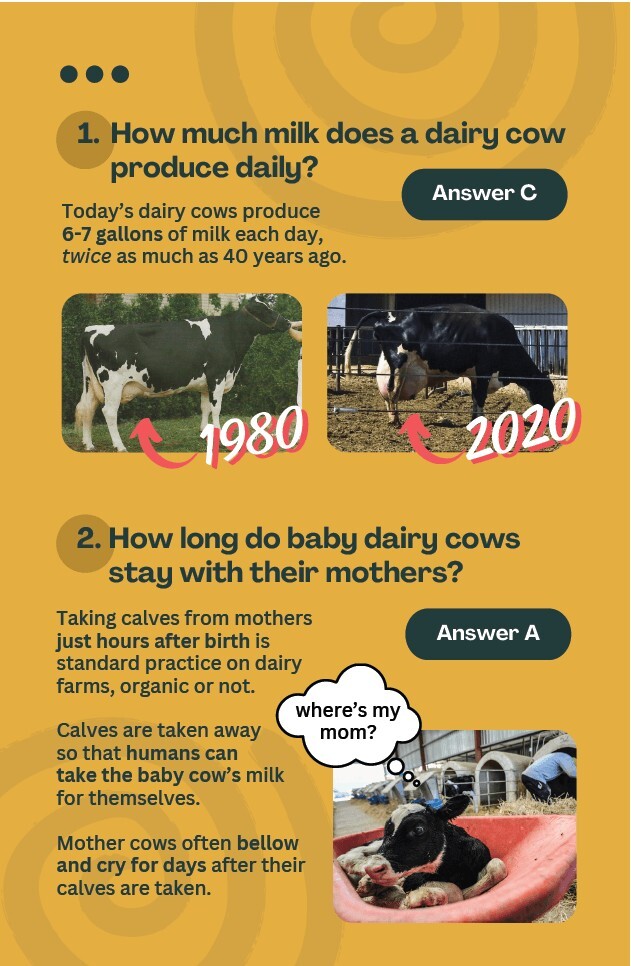
Visitors to our booth were invited to take a quiz in exchange for a plant-based milk or milk chocolate treat!
Quiz for Adults
Answers are at the end of this post.
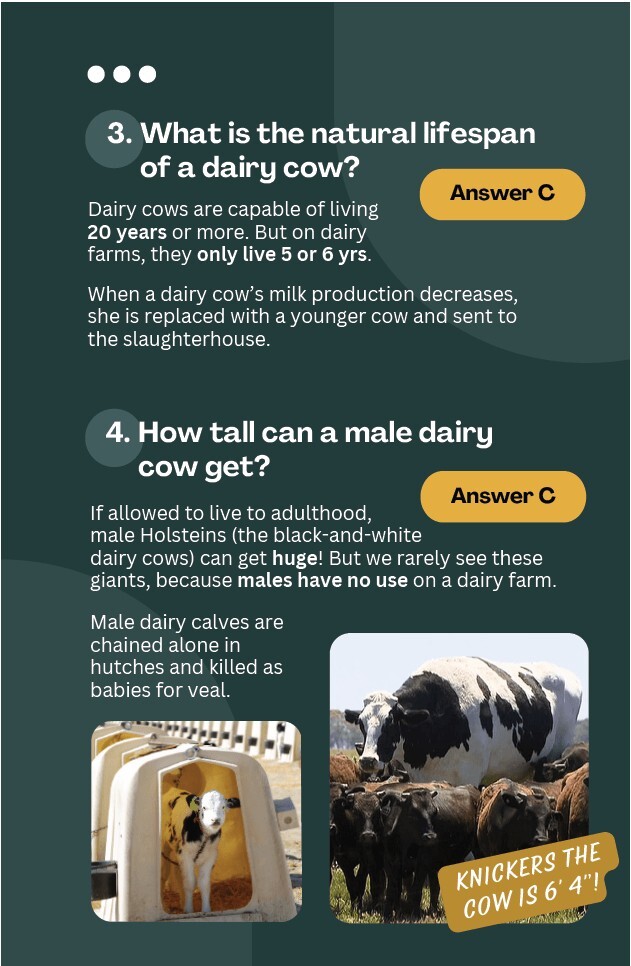
Quiz for Kids
Answers are at the end of this post.
Reactions and Results
Very few adults or kids got 100% on the quizzes. As we helped people correct their tests, we indirectly revealed the suffering and exploitation that takes place on dairy farms.
The folks who did do well on the quizzes were the dairy farmers and their families. And since the Farm and Forest Expo is a trade show for people who grow crops, trees, and, of course, animals, we met a lot of dairy farmers.
Surprisingly, many dairy farmers happily took the quiz. Some are so steeped in the industry, that they matter-of-factly answered the questions correctly without even recognizing that we were making the point that dairy is cruel.
Others were defensive and wanted to argue. They told us that they take good care of their animals, not like factory farms. We had long conversations with some of these folks, acknowledging that they care but also maintaining that dairy and animal agriculture are fundamentally cruel.
The NH Dept. of Agriculture was at the event, and based on our observations and interactions, there was clearly a contingent who were unhappy with our presence.
On the bright side, we met a handful of vegans and vegetarians, and just about everyone who sampled the Not Milk chocolate milk, Silk vanilla milk, Ripple original milk, plant-based Reeses, or Lindt oat milk chocolate bar, declared it to be delicious. (Of course, some stubbornly refused to even try what we were offering.)
Free Pins!
Kids enjoyed selecting from an assortment of free pins. It was a hoot watching kids from meat-eating families joyfully pinning on “Friends Not Food” buttons.
Lighthearted Posters
We purchased four fun and colorful posters online to make the case for ditching dairy in a lighthearted way.
Quiz Answers!
Answers to the Kids’ quiz:
Answers to the Adult quiz:
We are working on tabulating the answers for the completed quizzes so we can see what percentage of people got each question right or wrong. We’ll post the result here once we have them
Unhappy Sights
Naturally, we saw beasts of burden and other exploited animals at the event.
There was also a distressing exhibit put on by New Hampshire State Parks inviting visitors to match the skulls of dead animals with their pelts and trying to pass itself off as “conservation.” Some of us expressed our dismay and were told that the animals had died of natural causes.
Someone in the parking lot had this poster on their windshield.
Wonder who? 🙂
Let Go and Let Nature Be
The world is losing nature at a remarkable pace, and New Hampshire is no exception. The crisis spares no creature — mammals, fish, birds, amphibians, reptiles, and even the tiniest invertebrates are disappearing.
The culprits? Rampant development, widespread pesticide use, and climate change. Safeguarding habitats is no longer enough — we must enable nature to expand.
The good news is that simply by letting land be, allowing nature to reclaim its space, we can help imperiled species rebound.
83% of land in the U.S. is privately owned. If we planted native on 50% of private land we would restore biodiversity… and we can do it starting NOW.
Doug Tallamy
9 ways to promote wildlife
- Don’t mow
- Leave leaves
- Keep your trees!
- Plant for pollinators
- Landscape for wildlife
- Use non-lethal methods to deter unwelcome wildlife
- Lights off at night
- Retire your bug zapper
- Build homes for animals
Pledge A Plot
How much of your land are you prepared to dedicate to the wild?Resources
- Doug Tallamy’s Homegrown National Park
- Nancy Lawson, The Humane Gardener
NHARL Turtle Brigade
Turtles look tough, but they are in trouble! New Hampshire has 7 species of turtles, and 4 are considered in greatest need of conservation.
Major threats to turtles include loss of habitat due to development and roadways. Other threats include plastic trash, dogs, non-native turtles released into the wild, and the illegal wildlife trade — that’s right, people actually steal turtles from their natural habitats here in New Hampshire and sell them, often to China.
Every turtle is a miracle! Eggs and young turtles are food for many other animals. A turtle that beats the odds and makes it to adulthood can take up to 20 years to reproduce.
Ways to help turtles
- Watch for turtles crossing the road and assist them if necessary
- Support conservation efforts
- Don’t disturb nesting turtles
- Watch dogs around wetlands
- Learn your turtles and report sightings to
RAARP@wildlife.nh.gov - Contact NHARL to help us help turtles!
The Ride of the Turtle Brigade
On June 8, 2024, the Turtle Brigade embarked on its very first mission. Our assignment? To remind the public that it’s turtle crossing season and to LOOK OUT!
Tessa, the giant paper mache turtle, led the way as the brigade traveled from Milford, north to Goffstown, and then east to Bedford.
At predetermined locations along this route, the brigade created a spectacle and erected signs at known turtle crossing sites. The signs are intended to remain for the season and will be removed in the fall.
Fortunately, we had lovely weather, so Tessa was able to stay atop the vehicle upon which she was born to ride.
Working as a team, we were able to erect signs quite efficiently, though we did encounter a few obstacles.
The lessons we learned from the mission will help make next year’s turtle brigade even better! If you’d like to help, sign up for the Turtle Brigade (above). Monthly planning meetings will begin the first week in September. We need your creative ideas and expertise.
Our native turtles face many challenges, of which car collisions are only one. However, “every turtle is a miracle”, and every turtle matters. So, even if we helped one turtle make it across the road this season unharmed, it was worth the effort.
Oh, and we forgot to mention, it was also quite fun!
Delicious Time at Build-A-Cookie
We had a great time visiting with old and new friends at Build-A-Cookie, located in the Fox Run Mall in Newington, Saturday, March 16.
The NHARL-inspired “Lucky Dog” cookie was featured along with many other cruelty-free, allergen-friendly, and gluten-free treats.
Huge thanks to cookie queen Alex and her Build-A-Cookie team for their delicious baked goods and support.
If you missed the meetup, be sure to visit Build-A-Cookie another time — they are open Thu, Fri, and Sat from 10:00 – 5:00 — and tell Alex NHARL sent you!
Joining the fun were lucky dogs “Sunny” (left) and “Kowalski” (right) who enjoyed the dog-friendliness of the mall (but not really each other).
Kangaroos Are Not Shoes! (Repeat Performance)
Chanting “Kangaroos Are Not Shoes — Don’t Be a Dick’s,” the New Hampshire Animal Rights League once again stormed Dick’s Sporting Goods, this time in Concord, calling on the store to stop selling shoes made from kangaroo skins.
Dick’s Sporting Goods is the country’s largest distributor of kangaroo-based soccer cleats made by Germany-based Adidas, Japanese-based Mizuno, and other companies.
Australia’s commercial kangaroo industry kills almost two million wild kangaroos each year. Commercial shooters are permitted to kill mother kangaroos even when the joeys are still in their pouch.
Joeys are left to die, bludgeoned to death, or decapitated (see “Guidelines for euthanasia of dependent young and wounded or injured kangaroos” in Australia’s National Code of Practice for the Humane Shooting of Kangaroos and Wallabies).
The kangaroo massacre represents the world’s largest slaughter of land-based wildlife on the planet.
The protest was in support of the Kangaroos Are Not Shoes campaign by the Center for a Humane Economy. Since the launch of the campaign, Puma, Nike, and New Balance have all announced commitments to halt the sale of kangaroo-based shoes.
A Bit of Media Coverage
Newspaper coverage of our protest caught the attention of InDepth NH reporter Roger Wood, who then interviewed NHARL president Joan O’Brien for his podcast.
Kangaroos Are Not Shoes!
Chanting “Kangaroos Are Not Shoes — Don’t Be a Dick’s,” the New Hampshire Animal Rights League stormed Dick’s Sporting Goods at the Mall of New Hampshire calling on the store to stop selling shoes made from kangaroo skins.
Dick’s Sporting Goods is the country’s largest distributor of kangaroo-based soccer cleats made by Germany-based Adidas, Japanese-based Mizuno, and other companies.
Australia’s commercial kangaroo industry kills almost two million wild kangaroos each year. Commercial shooters are permitted to kill mother kangaroos even when the joeys are still in their pouch.
Joeys are left to die, bludgeoned to death, or decapitated (see “Guidelines for euthanasia of dependent young and wounded or injured kangaroos” in Australia’s National Code of Practice for the Humane Shooting of Kangaroos and Wallabies).
The kangaroo massacre represents the world’s largest slaughter of land-based wildlife on the planet.
The protest was in support of the Kangaroos Are Not Shoes campaign by the Center for a Humane Economy. Since the launch of the campaign, Puma, Nike, and New Balance have all announced commitments to halt the sale of kangaroo-based shoes.
Squirrels and coyotes debated in NH Senate committee
by RICK GREEN for the Keene Sentinel
January 11, 2024
The value of gray squirrels and coyotes was debated at an N.H. Senate committee meeting this week, with some speakers labeling them as a plentiful nuisance and others saying they are worthy of protection.
At issue were two bills, one to ban using dogs to hunt coyotes and the other to allow gray squirrels to be hunted year-round.
State Sen. Tim Lang, R-Sanbornton, is the prime sponsor of Senate Bill 548, which would change the definition of the furry rodent, specifying that it should no longer be considered a game animal.
The N.H. Fish and Game Commission regulates game animals, including setting seasons for when they can be legally hunted. If the gray squirrel was no longer considered a game animal, these regulations would end and hunters could kill them at will.
The current season for hunting gray squirrels is Sept. 1 through Jan. 31. A hunter’s daily limit is five. The season is intended to give time for gray squirrels to reproduce and raise their pups.
But Lang said there are so many gray squirrels that there is no reason for the state to impose any restrictions on those who want to hunt them. He also said many hunters teach their children to hunt by shooting squirrels. Some people eat the small animals, he added.
“Due to prolific breeding, they self-manage their own population,” Lang told the Senate Energy and Natural Resources Committee on Tuesday.
He said they produce two litters a year, each containing several pups. Lang noted that their population rebounded even after the “squirrel apocalypse” of 2018. That’s when there was a lack of nuts, squirrels had to roam far and wide to get food, cars hit them by the thousands and their carcasses were frequently found on roads.
N.H. Sen. Kevin Avard, R-Nashua, also noted squirrels get into attics and cause thousands of dollars in damage. (State law allows property owners to eradicate animals out of season if they are damaging their property.)
N.H. Sen. David Watters, D-Dover, questioned whether his fellow lawmakers were considering the full picture.
“One wonders whether this living animal is just target practice,” Watters said. “How is killing for the sake of killing something that is in accord with something we want to teach our children?”
Lang tried to pass a similar bill two years ago, but said it was flawed because it sought to change a wrong statute. It died in the Senate.
Weldon Bosworth, who holds a doctorate in biology and is a member of the N.H. Wildlife Coalition, called the bill “regressive and ill-thought-out.”
“You wouldn’t have forests spread all around if you didn’t have squirrels,” he said. “They spread the seeds. They serve as prey to some of our most iconic predators – foxes, fishers, coyotes. You wouldn’t have those if they didn’t have prey.”
He also questioned the motives of those who want a year-round season on gray squirrels.
“This bill is for those people who get their jollies by killing wildlife animals instead of going to the target range,” he said.
He said killing them over the summer when they are trying to reproduce is “sort of morally reprehensible to me.”
Dan Bergeron, chief of the state Fish and Game Department’s Wildlife Division, opposed the bill. He said there is a possibility of over-hunting gray squirrels and added that the department would like to leave the regulations as is.
The committee on Tuesday also considered Senate Bill 346, which would ban the use of dogs in hunting coyotes.
Watters, who is the prime sponsor of the legislation, said this hunting method is cruel to the dogs. He said dogs wearing GPS collars chase the coyote, and when it is exhausted or cornered, there is a fight to the death if the hunter isn’t on the scene quick enough to shoot the coyote.
Testifying in opposition to the bill was David Blaze, a wildlife control operator who uses dogs to hunt coyotes that have become a nuisance to farmers. He noted that the coyote is a predator that sometimes kills domesticated animals, including pigs, chickens and even dogs.
“Those lost dog posters, we all know what those really mean – the dog has been snatched by a coyote,” he said.
Blaze also said it’s difficult to successfully hunt a coyote without using dogs. He also said fighting does not occur and the dogs are not harmed.
Bergeron, from the N.H. Fish and Game Department, opposed the bill. He said further study is needed on coyote hunting in the state, but added there seems to be a plentiful population of these animals.
Bosworth, of the N.H. Wildlife Coalition, testified that hunting coyotes with dogs is “gruesome.” Advocates of such hunting say it has a long tradition.
“But there are a number of traditions that humans have had that are basically for entertainment but are cruelty for animals – bear baiting, cock fighting, dog fighting.”
N.H. Sen. Howard Pearl, R-Loudon, said anyone who has seen a coyote kill a domestic animal would support all measures of hunting the predator.
But Bosworth said that kind of thinking has been devastating to some animal species.
“That was actually the opinion back in the 1800s when we wiped out all the wolves in New Hampshire and all the mountain lions,” he said. “And I disagree with that in its entirety.”
The committee took no immediate action on either bill. It will eventually schedule a vote on whether to recommend the measures to the full Senate.